
elderbrook solutions
Valido - Quontrol Suite
Quontrol is elderbrook’s suite for planning, managing and documenting quality business processes. With its generic workflow engine, information libraries and template integration, Quontrol empowers organizations to gain and maintain full control of their quality processes.
Valido is the first comprehensive solution to bring the Quontrol approach to life. It takes over the busywork, allowing teams to focus on important tasks while providing full documentation of system validation status throughout each system’s life cycle.
Easy-to-use Computerized System Validation Management Tool
Save up to 75% of validation time
Why validate?
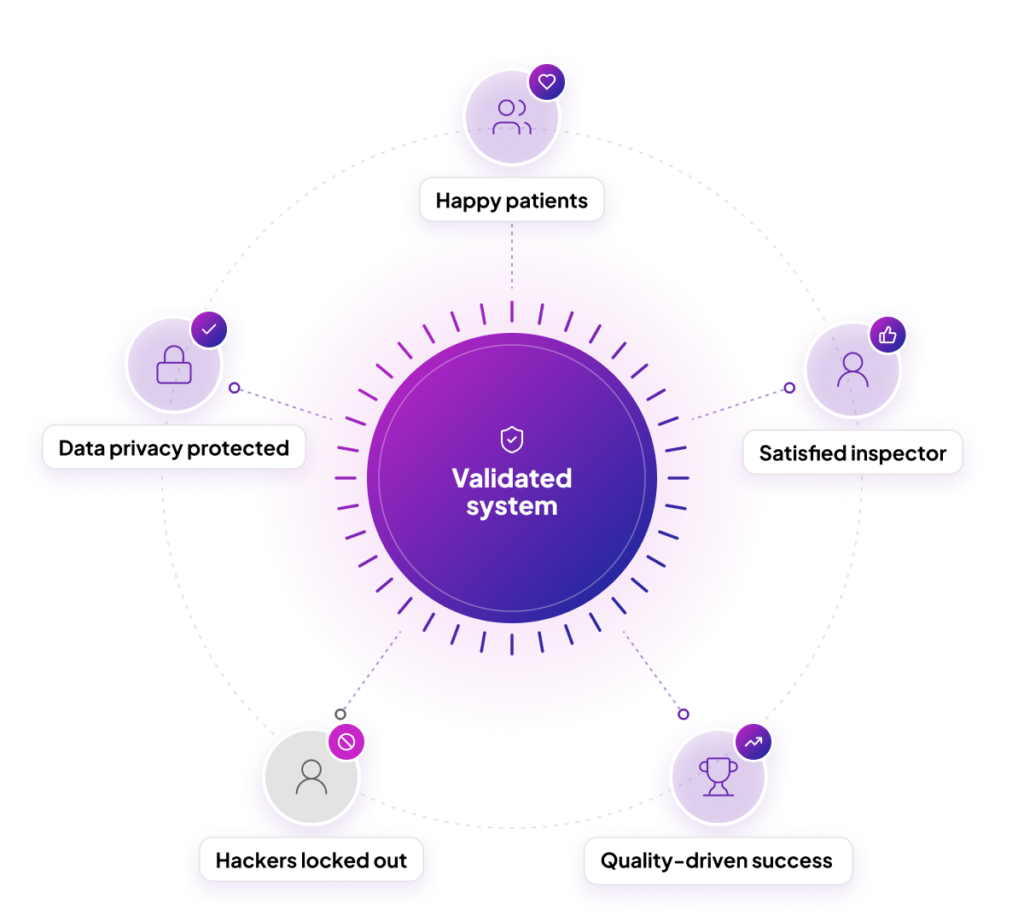
Well, we have to. GxP regulations (see the most relevant ones below) are quite clear about that. And it is not mainly about the documentation of the proper functioning of software, this is the manufacturer’s responsibility (while, of course, you have to prove that you’ve checked it!).
ICH E6 R3 aims to provide a unified standard to facilitate the mutual acceptance of clinical trial data for ICH member countries and regions by applicable regulatory authorities by fostering a quality culture and proactively designing quality into clinical trials and drug development planning, identifying factors critical to trial quality, engaging interested parties, as appropriate, and using a proportionate risk-based approach.
EudraLex Volume 4, Annex 11, highlights the common approach between member states of the European Union (EU) and the Pharmaceutical Inspection Co-operation Scheme (PIC/S), outlining the requirements for the use of computerised systems in GMP-regulated activities, thereby ensuring product quality, patient safety and data integrity.
ICH Q9 provides guidance on the principles and some of the tools of quality risk management that can enable more effective and consistent risk-based decisions, both by regulators and industry, regarding the quality of drug substances and drug (medicinal) products across the product lifecycle.
GDPR lays down rules relating to the protection of fundamental rights and freedoms of natural persons and in particular their right to the protection of personal data with regard to the processing of personal data and rules relating to the free movement of personal data.
Validate efficiently!
To comply with these regulations, we need to identify and assess risks related to the following aspects:
- Patient safety and welfare (GxP relevance)
- Technical complexity (Gamp5 Category)
- Business data protection
- Data privacy protection
Using a risk-based approach, you would perform an initial risk assessment to assess the severity of the consequences of a potential error. A potential error in a system that is considered less risky in terms of the aforementioned risks would have less severe consequences than the same error in a system classified as risky.
It is therefore acceptable to conduct a less detailed root cause analysis in a low-risk system than in a high-risk system.
After all, a detailed root cause analysis takes time—considerably more time than assessing the overall system risk.
The same applies to individual user requirements if we need to evaluate them separately in a high-risk system: For many of them, a risk can be ruled out or classified as below a threshold value, meaning that testing that requirement is unnecessary.
After all, testing takes time—considerably more time than assessing the risk of individual requirements.
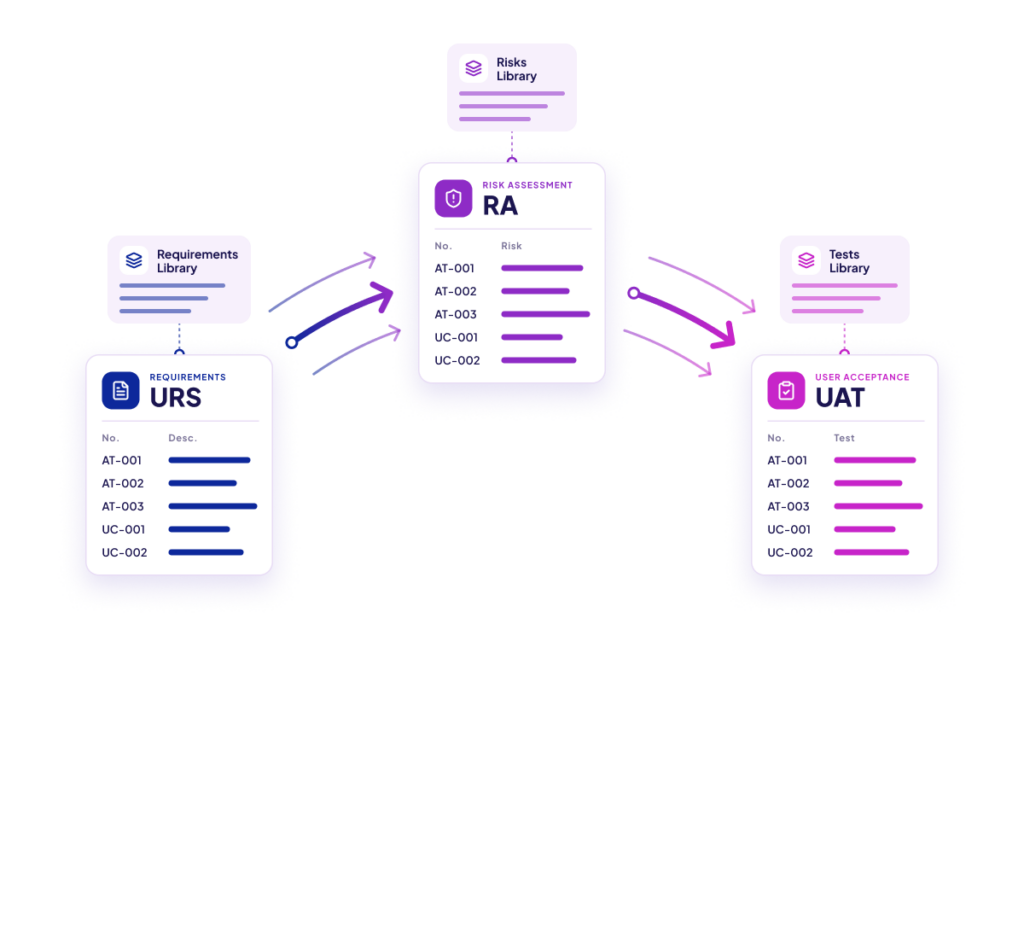
This is how the sequence of the well-known document templates comes about—they are not only required by law and sensible in terms of content; above all, they serve to bring to life values that would otherwise remain mere words on paper.
Pain Points
Computerized System Validation (CSV) or Computer Software Assurance (CSA) is cumbersome. The initial validation of a system and keeping it in a validated state cost time and resources. This may even become an obstacle for setting productive an urgently needed system or a release update. Or, worse, it may become the reason for setting it productive without proper validation.
But what makes the validation process so unpopular?
Numerous regulations
- needs to be implemented in CSV SOP(s)…
- resulting in numerous templates…
- with a lot of information to be collected…
- with many repetitions…
- and links to be maintained…
- requiring decisions and process bifurcations…
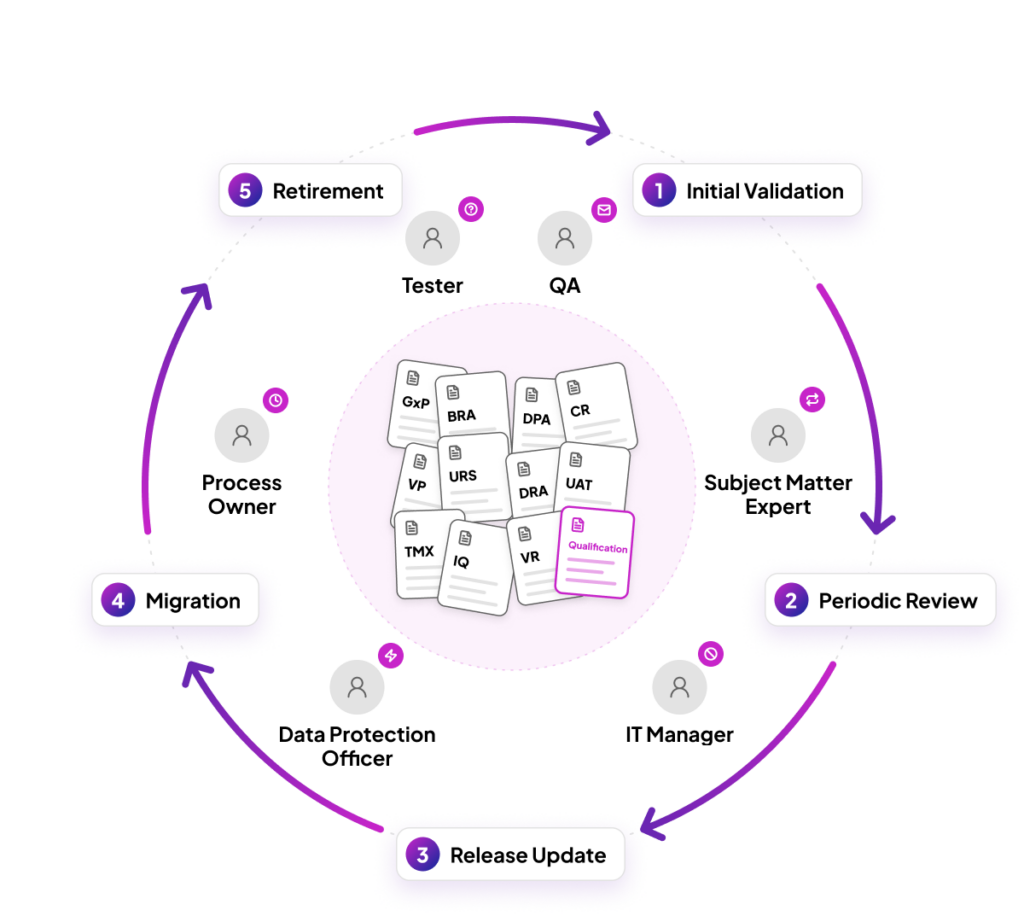
… and all this throughout the entire lifecycle. In short, validation, though reasonable and necessary, is something you’d rather have done than be doing.
Take it easy!
- Have your own SOPs transformed into an executable workflow.
- Have your validation templates completed according to your own SOPs.
- Let Valido manage tasks and collaboration according to your individual role concept and validation process workflow
- Let Valido include data (e. g. user requirements, test scripts) delivered by the system vendor and maintain the linking between them.
- Valido provides oversight over the entire system lifecycle including release updates, periodic review, system retirement.
- Roadmap: Valido performs gap analysis between regulatory requirements and your validation framework .
FAQ
Why do computerized systems need to be validated?
Because GxP regulations require it. Validation shows that a system is fit for its intended use in your organization and stays that way throughout its life cycle. This protects patient safety, product quality and data integrity.
Isn’t it the software vendor’s job to prove that the software works?
Partly. Documenting that the software works correctly is the manufacturer’s responsibility. Your responsibility is to show that you have checked it, and that the system is suitable, controlled and documented for the way you use it.
Which regulations are most relevant?
- ICH E6(R3) sets a unified standard for clinical trials so that trial data can be mutually accepted across ICH regions. It focuses on a quality culture, building quality in from the start, identifying factors critical to trial quality and using a proportionate, risk-based approach.
- EudraLex Volume 4, Annex 11 is the common approach of the EU member states and PIC/S. It sets out requirements for computerised systems in GMP-regulated activities to ensure product quality, patient safety and data integrity.
- ICH Q9 covers the principles and tools of quality risk management. It supports consistent, risk-based decisions across the product life cycle, for both regulators and industry.
- GDPR protects the rights of individuals with regard to the processing of their personal data.
What does a risk-based approach to validation mean?
You start with an initial risk assessment covering four aspects: patient safety and welfare (GxP relevance), technical complexity (GAMP 5 category), business data protection and data privacy protection. The higher the risk, the more severe the consequences of a potential error, and the more detailed the validation needs to be. A low-risk system can be validated with less in-depth analysis than a high-risk one.
Do all user requirements need to be tested?
No. In a high-risk system, you can assess the risk of each requirement individually. For many of them, the risk can be ruled out or falls below a defined threshold, so testing them isn’t necessary. Assessing a risk takes far less time than testing, so this approach saves considerable effort. It is also why validation documents follow their well-known sequence: they turn quality values into everyday practice instead of leaving them as words on paper.
Why does validation often feel so cumbersome?
Many regulations need to be translated into CSV SOPs. This results in numerous templates that require a lot of information, repeated entries, links that must be maintained, and decisions that branch the process. All of this continues across the system’s entire life cycle. As a result, validation can delay an urgently needed system or release update. In the worst case, a system goes live without proper validation.
What is Quontrol?
Quontrol is elderbrook’s suite for planning, managing and documenting quality business processes. Its generic workflow engine, information libraries and template integration help organizations gain and keep full control of their quality processes.
What is Valido?
Valido is an easy-to-use management tool for Computerized System Validation. It is the first complete solution built on the Quontrol approach. Valido takes over the busywork so your team can focus on what matters, and it documents each system’s validation status throughout its life cycle. The BSFZ certified the development of Valido as innovative research in 2026.
Who is Valido for?
Valido is for life-science teams who validate systems such as EDC, CTMS, eTMF or eQMS. It is also for software vendors whose customers need to validate their products, and for CSV consultants who carry out validation for their clients.
How does Valido save time?
Valido handles the manual work: anything you would otherwise look up, calculate or enter twice. Requirements, risk assessments and tests stay linked automatically. Pre-filled libraries reduce setup effort, and tasks are routed to the right people so work can happen in parallel. This means up to 75% less validation time.
Can we use our own SOPs and templates?
Yes. Upload your own templates and Valido fills in the data. Validation follows the workflows defined in your SOPs, for example one workflow for CSV and another for SAS macros.
What is in the pre-filled library?
The library contains ready-to-use user requirements and test scripts provided by system vendors. You can insert them with one click and edit them freely. Valido takes care of traceability.
Does Valido cover the entire system life cycle?
Yes. Valido covers everything from initial validation through periodic reviews, release updates, migrations and revalidations to retirement. It keeps documents, responsibilities and open tasks together for every system, so you always have an inspection-ready overview.
How does Valido assign tasks?
Following your SOPs, Valido assigns tasks across roles and departments and notifies the right people automatically. This allows parallel work without delays.
I’m a software vendor. How can Valido help me?
If customers hesitate to buy your software because of the validation effort, Valido lowers that barrier. With the Partner Bundle, you can provide validation information, requirements, risks and tests for your system. This helps customers validate faster and adopt updates sooner, so you can retire old versions earlier.
Which plans are available?
Expect our plans to be published in Q1 2027. We will provide a stage approach depending on your validation burden to match your individual requirements.
Do you offer support?
Yes. The elderbrook team supports you personally, with services ranging from setup, helpdesk support and best practices to running entire validation projects.
How can I see Valido in action?
Contact us or book a live demo at elderbrook.de/valido.

Contact Us!
Whether you’d like to see Valido in action, discuss a specific system or simply ask a question, our team is happy to help. Book a live demo or contact us directly.
Claudia Horneck